 Pancakeswap
 ties swaps, cross-chain transfers, liquidity, earning, and derivatives to distinct wallet commitments.
Updated ·
Pancakeswap is a multichain decentralized exchange where a connected wallet can quote swaps, move supported assets across networks, supply liquidity, and open other market positions. The commitment changes by action: a quote can be left untouched, an approval grants spending permission, and a signed transaction can alter balances after network acceptance.
What's inside
Actions share prerequisite state
A connected wallet supplies the address, selected network, asset balances, and permissions each action needs. The network must support the chosen product, the input asset must exist there, and the wallet normally needs that network's native token for gas. Check these conditions before signing or submitting an action; a quote or projected return doesn't prove the wallet can complete it.
The products connect through their use of assets and market liquidity. Swaps consume available liquidity, while liquidity providers supply assets to pools and may receive trading fees. Eligible positions may also participate in farming incentives. Cross-chain tools add a bridge route between networks, while derivatives use collateral to create exposure without performing an ordinary token exchange.
That shared interface doesn't create a shared exit path. A spot swap settles into wallet balances. A liquidity deposit creates a position requiring removal later. A bridge waits for delivery on another network, and a derivative remains open until it is closed or liquidated. The intended end state should therefore be clear before the first permission is granted.
Where does a choice become a commitment?
A token choice, amount, and displayed quote remain reversible while they exist only in the interface. Closing the window or changing an input doesn't move assets.
An approval transaction is the first possible on-chain commitment for many token actions. It authorizes a specified contract to spend up to an allowed amount. The approval doesn't perform the swap, and unused allowance may remain after the transaction unless it is exhausted or revoked.
The action itself reaches a different boundary when the wallet signs and submits it. Before signing, the wallet should show the selected network and the operation being requested. After submission, the transaction may be pending, confirmed, or failed. An interface spinner isn't proof of any of those states.
Some commitments continue beyond settlement. Liquidity remains exposed to pool prices until it is removed. A limit order may wait for its execution condition. Collateral assigned to a leveraged position remains subject to that market's margin rules while the position is open.
If the displayed route, amount, allowance, or expected output no longer matches the intended action, stop before granting the relevant permission or submitting the transaction. Once confirmation changes the chain state, reversing the economic effect usually requires a new transaction rather than an undo command.
A swap quote sets the immediate boundary
A swap quote links the input amount to a route through available liquidity. The route may use one pool or several hops. Each hop can add a pool fee and contribute to the route's overall price impact. A larger order relative to available liquidity generally shifts the pool price further, so splitting or rerouting may produce a different outcome.
Slippage tolerance defines the maximum adverse price movement a pool swap may accept before execution fails. The minimum received amount expresses that protection as an output quantity. Raising tolerance can reduce failures during volatile conditions, but it also widens the result the transaction will accept. Price impact is different: it estimates how the trade itself changes the pool price.
Quotes can update before signature because reserves, routes, gas estimates, and market prices change. A failed on-chain attempt generally leaves the intended asset exchange unapplied, although the network can still charge gas for processing the reverted transaction. That makes the quote deadline and wallet confirmation part of the decision, not clerical details.
A standard swap from selection to settlement
This sequence traces a standard on-chain pool swap. It keeps the action reversible through quote review, identifies the permission boundary, and ends with evidence from the network rather than a temporary interface message.
| Stage | Condition or outcome |
|---|---|
| Match the wallet and network | The selected network must support the action before a usable quote can appear. |
| Choose the input and output assets | One asset pair defines the initial search for available routes and liquidity. |
| Enter the input amount | The quote uses the entered amount and available liquidity; the wallet balance determines whether that input can be submitted. |
| Review the route and output limits | The displayed route, price impact, minimum received, fees, and gas estimate apply to that quote. |
| Authorize the input when required | A token may require a separate approval or signature before the swap; this permission doesn't execute the trade. |
| Sign and submit the swap | Signing and submitting crosses the transaction commitment boundary and sends the action for network processing. |
| Wait for settlement | Confirmation time depends on the network and congestion; the final status may be confirmed or failed. |
| Summary | Selections remain reversible until permission or submission, while the transaction record supplies the final state. |
A network change, refreshed quote, altered balance, or unexpected approval request invalidates the earlier review. Stop at that point and generate a fresh quote. If the transaction was already submitted, inspect its status before retrying, since a second submission could duplicate an action the first transaction completed.
Route availability depends on the assets and networks
A supported token on one network doesn't establish a route to every other network. Spot swaps require accessible liquidity on the selected chain. Cross-chain swaps additionally need a compatible source, destination, asset path, and bridge provider. A route can disappear when liquidity, capacity, provider support, or transaction limits change.
Cross-chain execution combines separate mechanisms. The source side may swap the input into an asset the bridge accepts, the provider transfers value between networks, and the destination side may perform another swap. The final output therefore reflects more than one liquidity state. Review the destination network, received asset, provider, estimated delivery, fees, and minimum output together.
Gas is also network specific. The source wallet needs the appropriate native asset to initiate an on-chain transfer, and some routes may require destination-side gas for later use. Receiving a token doesn't automatically provide the native gas asset needed to move it again. Waiting or selecting another supported route preserves reversibility before submission.
Liquidity positions exchange flexibility for market exposure
Providing liquidity deposits assets into a pool so swaps can execute against them. In return, the provider receives a position representing a share of the deposited assets and accrued fees. The position's value can diverge from simply holding the original tokens because pool balances change as traders swap between them.
A V3 liquidity position is represented by a transferable NFT with its own fee tier and selected price range. It earns trading fees only while its range covers the active market price. Outside that range, the position becomes inactive and can consist entirely of one asset. If the price moves back into range, the same position can become active again.
V2 full-range pools represent ownership with fungible liquidity provider tokens instead. Both forms permit removal through an on-chain action, but neither guarantees the original token ratio or combined value. A narrower range concentrates liquidity and fee exposure, yet it also reaches an inactive state sooner when prices move. The range, fee tier, token pair, and exit plan all belong in the initial review.
What changes when the task is not a swap?
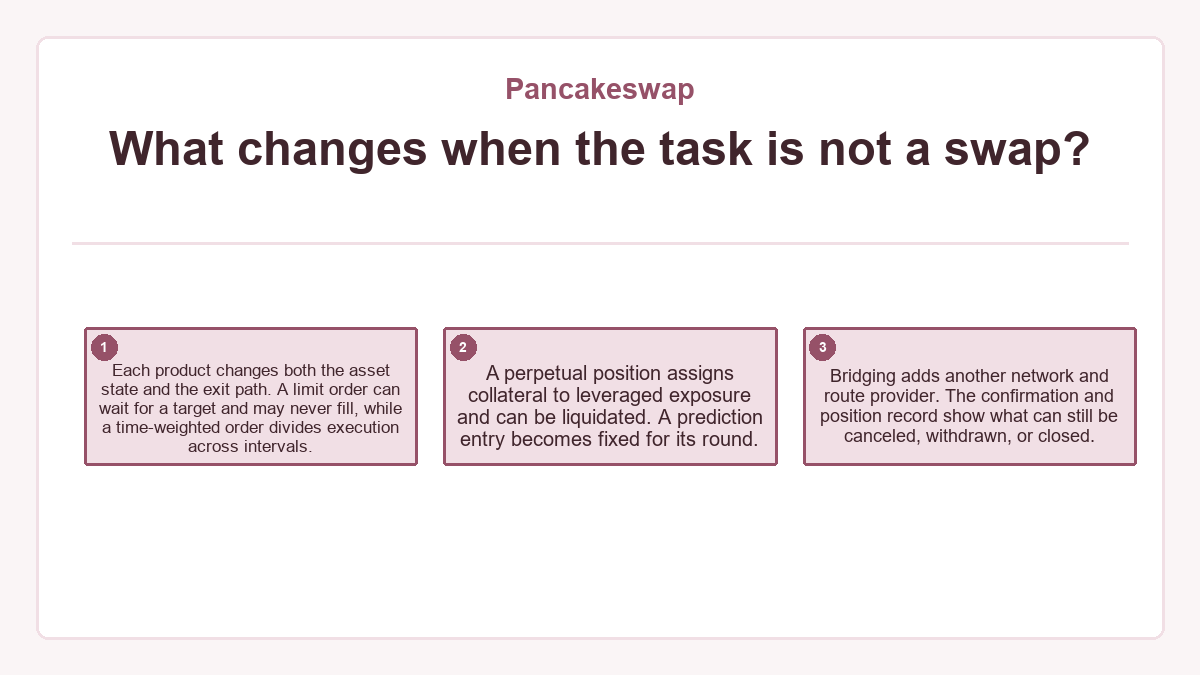
Each product changes both the asset state and the exit path. A limit order can wait for a target and may never fill, while a time-weighted order divides execution across intervals. A perpetual position assigns collateral to leveraged exposure and can be liquidated. A prediction entry becomes fixed for its round. Bridging adds another network and route provider. The confirmation and position record show what can still be canceled, withdrawn, or closed.
Earning paths use different commitments
Pool fees come from swaps using a liquidity position. Farming incentives are separate rewards attached to eligible pools or positions, while an available single-token pool may accept one asset without creating a two-token liquidity position. These mechanisms shouldn't be treated as interchangeable yields because they expose different assets and depend on different contracts.
A displayed annualized rate is an estimate built from changing inputs, such as reward emissions, token value, trading volume, fee generation, and deposited liquidity. It doesn't lock a future return. For concentrated liquidity, only active in-range capital earns pool fees. Farming eligibility can also change without altering the underlying ownership of the liquidity position.
Collection and exit mechanics matter at small scales. Claiming rewards, adjusting a range, unstaking a position, or removing liquidity may each require a transaction and gas. Leaving rewards unclaimed reduces transaction frequency but maintains contract exposure. Claiming more often realizes the balance sooner but can make network costs a larger share of the amount collected.
Perpetuals and prediction set harder boundaries
Perpetual contracts have no scheduled expiry and use margin to create long or short price exposure. Leverage makes the position larger than the posted collateral, which increases both gains and losses relative to that collateral. Funding payments, trading fees, price movement, and maintenance margin can change the position until it is closed or liquidated.
Perpetual engines may require funds to be deposited into a trading contract or account before orders can open. The relevant market, collateral asset, leverage, liquidation price, order type, and withdrawal path must be reviewed inside that engine. A spot-wallet balance doesn't automatically serve as collateral.
Prediction markets use a different commitment. An entry selects an outcome for a defined round, and the choice can't be edited after it is locked. Settlement follows the market's designated price mechanism rather than the live chart alone. The entry amount, lock state, round result, and claim status provide the useful evidence.
Total cost has several moving parts
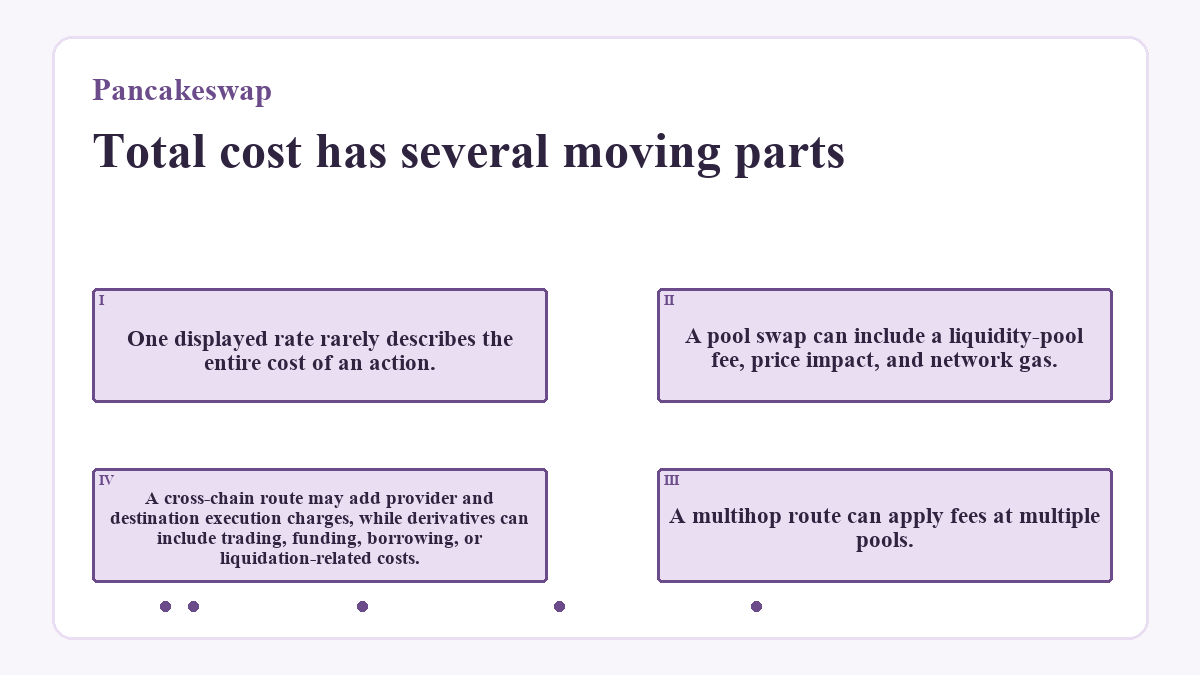
One displayed rate rarely describes the entire cost of an action. A pool swap can include a liquidity-pool fee, price impact, and network gas. A multihop route can apply fees at multiple pools. A cross-chain route may add provider and destination execution charges, while derivatives can include trading, funding, borrowing, or liquidation-related costs.
Slippage isn't a quoted fee. It is an execution boundary, and unused tolerance isn't automatically charged. Price impact isn't a separate invoice either; it appears in the exchange rate produced by the pool. Keeping these categories separate makes two routes easier to compare on the same input amount and intended output.
Small transactions can be disproportionately affected by fixed or weakly size-dependent network costs. Large transactions can face more price impact when liquidity is limited. The useful comparison is the final expected output, total displayed charges, acceptable minimum, and resulting position state. A headline fee by itself doesn't capture those differences.
The final record decides what happened
A completed action should leave matching evidence in the transaction status, wallet balances, allowances, and any resulting position record. A failed atomic swap should leave the intended exchange unapplied, though gas may be spent. A cross-chain route or staged order can stop after an intermediate step, so its route or order record must be checked before retrying. Pending activity needs resolution before a retry. Unlike a centralized exchange, where an internal account ledger records most actions, Pancakeswap actions usually depend on wallet signatures and public network records, with separate contracts or providers governing each product.
Frequently asked questions about Pancakeswap
-
Do I need an account to make a standard wallet swap?
- A standard wallet swap doesn't require a Pancakeswap username or a deposit into a platform account. The wallet address supplies the transaction identity and retains the resulting assets. Separate products, integrated providers, local access rules, or third-party payment services can impose their own requirements, so those conditions shouldn't be inferred from the swap interface.
-
Does a completed pool swap leave Pancakeswap holding my tokens?
- No, a standard pool swap exchanges assets through smart contracts and sends the output to the designated wallet address. That doesn't describe every product. Bridging relies on an integrated route provider, limit orders may remain pending, and derivatives can require collateral to stay in a contract or trading engine until the position closes.
-
Why does a token approval remain after the swap?
- An approval can remain because it controls spending allowance rather than one specific trade. If the allowed amount exceeds what the swap used, the unused portion persists until it is spent, replaced, or revoked. Limiting approval to the intended amount reduces the remaining allowance but may require another approval for a later action.
-
Can two tokens use the same ticker?
- Yes, a ticker and token name aren't unique identifiers. The network and token's contract or mint address identify a fungible token, while the ticker is only a display label. Selecting a lookalike asset can produce a valid transaction involving the wrong contract, so the intended network and address must match before approval or submission.
-
What happens when I switch networks in my wallet?
- Switching networks changes which chain state the wallet displays; it doesn't transfer assets. The same address can have unrelated balances, approvals, and positions on different networks. Moving value between them requires a supported bridge or cross-chain route, and the destination balance appears only after that separate operation settles.
-
Is gas still charged when an on-chain swap fails?
- Gas is generally charged when a submitted transaction reaches the network and then reverts, because validators still processed its computation. An action rejected before submission doesn't create that on-chain charge. The intended token exchange should revert with the failed transaction, although a separate approval completed earlier can remain active.
-
When does an out-of-range V3 position earn fees again?
- An out-of-range position resumes earning fees if the market price returns inside its selected range and its liquidity hasn't been removed. Re-entry doesn't require recreating the position. It won't earn fees while the price stays outside the range, and changing the range requires managing or replacing the existing liquidity position.