 Pancakeswap
 leaves swap choices editable until the wallet submits a transaction
Updated ·
Pancakeswap lets you change a swap's assets, amount, routing settings, and slippage tolerance before authorizing the swap in your wallet. Rejecting the swap request prevents that transaction from being submitted, although an earlier token approval can remain. After submission, cancellation becomes a race only when the wallet and network support replacement; the replacement must confirm before the swap.
Contents
In short: You can revise or reject a swap before submission. If the wallet and network support replacement, a cancellation must confirm before the original transaction.
Drafts, wallet prompts, and submitted transactions have different boundaries
The interface, wallet, and blockchain represent three different states. Knowing which state you're viewing tells you whether backing out requires no action, a rejected prompt, or a competing transaction.
Interface choices remain drafts
Selecting assets, entering an amount, adjusting slippage, or changing permitted routing sources doesn't move tokens. These choices produce a quote from the available liquidity and the settings you've selected. You can edit them, refresh the quote, or leave without creating a blockchain transaction.
A quote can change while you review it because routes, liquidity, and pool prices can change. The displayed output and price impact therefore describe the proposed swap, not a reserved exchange rate. Editing the amount or settings should produce a new quote for the revised request.
The wallet prompt contains the proposed action
Opening a wallet prompt still doesn't mean the swap has reached the network. Before approving it, review the account and network in the wallet, along with any contract, token amount, and network fee it displays. In the interface, compare the minimum received and price impact with the quote you intend to submit. If something doesn't match, reject the request and correct the draft in the interface. Nothing in a rejected swap prompt can later confirm because the wallet never submitted it.
Submission creates the pending state
Authorizing the transaction allows the wallet to broadcast it. At that point, changing the visible form or closing the page won't alter the submitted data. The network now decides whether the transaction confirms, fails, or disappears from its pending pool. Any attempt to cancel must act on that pending transaction rather than the old interface quote.
Token approval and swap submission remain separate
A token approval and the swap it enables can be distinct actions.
An approval can outlive the swap attempt
When an asset requires spending permission, the wallet may request approval before presenting the swap transaction. Once recorded, that allowance authorizes the specified spender up to its permitted amount. Rejecting the later swap prevents the trade from being submitted, but it doesn't erase an approval already recorded on the network.
The approval amount matters. A narrowly limited allowance restricts how much the spender may use, while a broader allowance can support later actions without another approval. The wallet may offer a custom spending limit, but the allowed amount must cover the intended input for the swap to proceed.
Revocation changes future access
Revoking an allowance sets a new on-chain permission, commonly zero or a lower amount. It doesn't recover assets from a completed trade or erase the approval's history. Because revocation is another network transaction, it needs confirmation and may incur gas. Until that transaction confirms, the earlier allowance remains the recorded state.
A pending swap has a narrow cancellation window
Pending doesn't mean editable. It means the original transaction has been broadcast but hasn't yet reached a confirmed outcome.
A cancellation competes for the same transaction slot
On networks and wallets supporting nonce-based replacement, a cancel function usually broadcasts another transaction using the original nonce and a higher fee. The replacement must reach validators and confirm before the swap. If the original wins that race, the cancellation can't pull it back. A confirmed replacement also consumes gas because the network processed it.
A speed-up command serves a different purpose. It rebroadcasts the intended action with a more competitive fee rather than withdrawing it. Check the wallet's wording closely so an attempt to cancel doesn't become an attempt to accelerate the swap.
Earlier pending actions can hold the queue
Transactions from one account often confirm in nonce order. A later swap or cancellation may wait behind the account's oldest pending transaction even when the newer action offers adequate gas. Resolve the oldest relevant entry first, then check whether the wallet still shows later requests as queued, replaced, or dropped.
Confirmation makes the state change permanent
A confirmed blockchain transaction cannot be reversed. Pancakeswap can't edit the confirmed input, restore the earlier pool state, or remove the transaction record. The resulting token transfers and balance changes remain part of the chain's history.
Trading back is a new swap, not an undo command. It uses the liquidity, route, price, slippage condition, and fees available when you submit the new transaction. Those inputs may differ from the original trade, so the return amount needn't equal what you first spent. Check the new quote as a separate decision.
A failed swap leaves some costs and permissions untouched
A failed on-chain swap doesn't deliver the proposed output because its contract execution reverts. On networks charging gas for execution, the attempt can still consume a network fee. The fee paid for computation isn't restored merely because the swap's execution condition failed.
Failure also doesn't undo a separate token approval completed beforehand. A price move beyond the permitted slippage, insufficient output, or another execution error can stop the swap while leaving the allowance intact. Review the approval independently before retrying, especially if the next attempt changes the amount or spender.
Disconnecting the wallet does not clean up on-chain state
Disconnecting removes the site's active connection to the wallet, but it doesn't cancel a pending transaction or revoke a recorded token allowance. Closing a browser tab has the same limitation. Both actions affect the current interface session rather than the blockchain.
Reconnecting may restore the account view, although the interface can take time to refresh its history. Use the transaction identifier and the relevant network record to determine what actually happened. If you no longer want an existing allowance, submit a revocation instead of relying on disconnection.
The last review should match the action you mean to sign
Before approving the wallet request, match the proposed action against these details.
- Confirm the wallet account and network match the assets shown in the swap.
- Check token identities and contract details rather than relying only on names or tickers.
- Compare the input, estimated output, minimum received, price impact, and slippage setting.
- Identify whether the prompt grants an allowance, submits the swap, speeds it up, or attempts cancellation.
- Resolve an older pending transaction before assuming a later request can confirm first.
If any field is wrong before submission, reject the prompt and rebuild the request. If the transaction is already pending, the next choice is whether to wait, replace it, or attempt cancellation through a method the wallet and network support.
The transaction record settles what happened
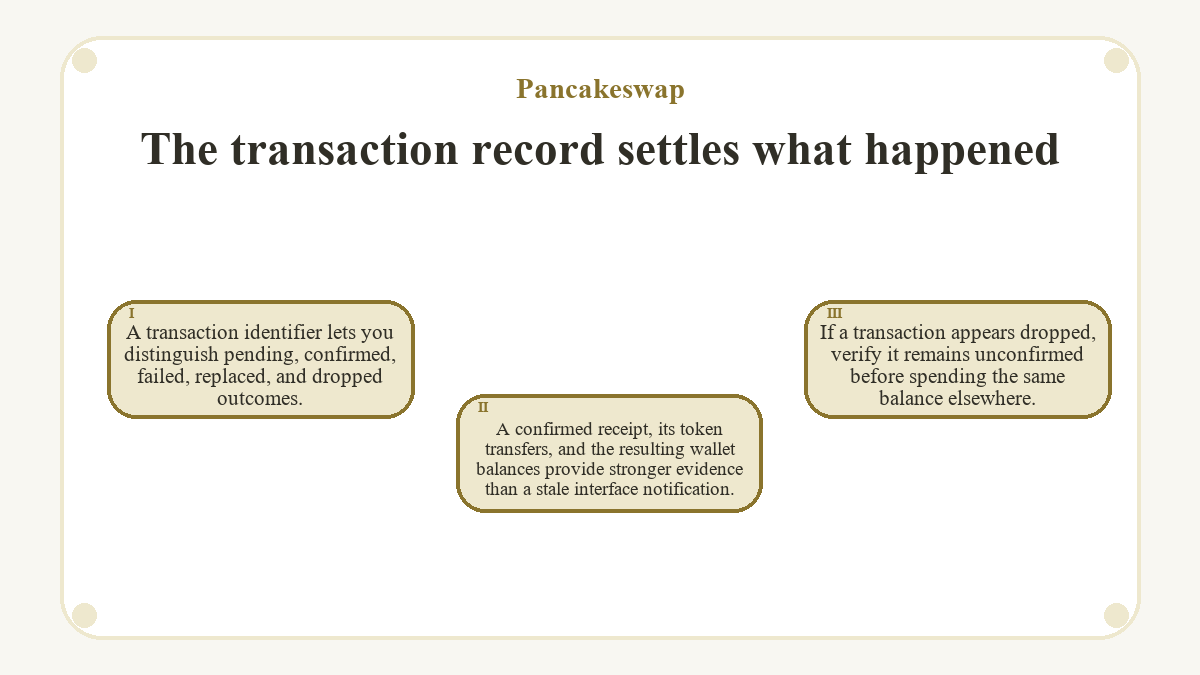
A transaction identifier lets you distinguish pending, confirmed, failed, replaced, and dropped outcomes. A confirmed receipt, its token transfers, and the resulting wallet balances provide stronger evidence than a stale interface notification. If a transaction appears dropped, verify it remains unconfirmed before spending the same balance elsewhere.
If a cancellation replacement confirms, the network can't later confirm the original transaction with the same nonce. If the swap confirms first, decide whether a separate swap is acceptable under the new quote. Then review any remaining token allowance as its own permission and either retain, reduce, or revoke it.
Key questions about Pancakeswap
Can I change the token amount after the wallet prompt opens?
Yes, provided you haven't authorized and submitted the swap. Reject or close the wallet prompt, return to the swap form, edit the amount, and review the refreshed quote. An approval completed before that prompt may remain active, so changing the amount doesn't automatically change or remove the existing allowance.
Does closing the browser cancel a pending Pancakeswap swap?
No, closing the browser only ends the visible session. A transaction already broadcast to the network remains pending until it confirms, fails, gets replaced, or drops from the pending pool. Reopen the wallet and inspect the transaction record before submitting another action from the same account.
What happens if the quote changes while I am reviewing the wallet request?
The displayed market quote may refresh, but an open wallet request represents the transaction data already prepared for signing. Reject it if the output condition or other details no longer match your intention, then request a new quote. Editing the web form doesn't rewrite a transaction already awaiting wallet authorization.
Is gas charged when I reject a wallet request?
A rejected request isn't broadcast, so the network doesn't execute it or charge gas for that request. Any earlier approval transaction remains separate: if that approval already confirmed, its gas cost and allowance remain. Always identify whether the wallet is showing an approval, swap, replacement, or cancellation before acting.
Does the speed-up option undo a submitted swap?
No, speeding up normally resubmits the same intended transaction with a more competitive fee. Its purpose is earlier processing, not cancellation. To stop a pending swap, the wallet must support a cancellation or replacement method, and that competing transaction must confirm before the original swap.
Why can a cancellation remain pending behind the original transaction?
The network hasn't yet confirmed either transaction, or an older nonce from the same account is blocking the queue. A cancellation must use the correct replacement mechanism and offer a fee capable of competing with the original. If the swap confirms first, the pending cancellation can no longer reverse it.
Can reducing slippage restore a swap that already confirmed?
No, slippage tolerance is an execution condition for a proposed transaction. It can cause a future swap to fail when the obtainable output falls below its limit, but it can't modify a confirmed trade. Returning to the earlier asset requires a new quote and a separate transaction under current conditions.
What remains after an on-chain swap fails?
The proposed asset exchange doesn't complete, but the network may still charge gas for processing the failed transaction. A token allowance established through an earlier approval can also remain active. Check the failure record and the current allowance separately before changing the quote or attempting the swap again.