 Pancakeswap
 Trading Fees can be reconciled by matching the quote to the final account state.
Updated ·
Pancakeswap Trading Fees can differ from a wallet's final balance change because the interface, wallet, and network describe different parts of one swap. Start with the quoted route and any displayed trading fee, then separate network gas, price impact, slippage protection, and any token-level transfer charge. Compare the same amount, direction, and network, then check whether the executed route differs from the quote and keep both timestamps. The confirmed transaction and resulting token balances settle the mismatch, while the saved quote records what the interface displayed before submission.
Where each cost first appears
The swap quote connects an input amount to an estimated output through available liquidity. Its route details identify the pools or market-making sources used and the trading fee attached to that route. Pool fees affect the quoted exchange rather than appearing later as an unrelated wallet debit. If a market maker fills the trade, the trader may pay no trading fee, so check the displayed fee instead of applying a pool rate.
The wallet adds a network-cost estimate for executing the transaction. After confirmation, the transaction record reports the network fee actually charged, while token transfers and final balances show the executed input and output. Reconciliation works only when each figure remains in its own category.
Pool fees, gas, price impact, and slippage have different jobs
A pool fee compensates liquidity providers and may allocate part of the charge elsewhere under the pool's rules. The applicable rate follows the selected route and pool configuration. It doesn't automatically match a remembered headline rate because the router can choose another pool type, tier, or combination of pools.
Gas pays for network computation and storage. Gas is charged in the network's fee asset, which may also be the swap input. The gas charge can change without any change to the pool fee. A separate approval transaction may also consume gas before the swap.
Price impact describes how the trade size and available liquidity affect the execution rate. Slippage tolerance sets an acceptable execution boundary if conditions move before submission or confirmation. Neither is an extra percentage automatically transferred to a fee recipient.
Why can the quote and final cost disagree?
The figures disagree when they cover different routes, account states, or moments. Liquidity can change, the router can find a new path, and the network's gas conditions can move between quote and confirmation. Changing the input amount or permitted routing sources also creates a new comparison, even when the token symbols remain unchanged.
Fiat displays add another moving input because their conversion price may update independently of the transaction. Compare token quantities and native network fees first. Convert them to a common currency only after fixing one valuation time, or a price move may look like an unexplained protocol charge.
Route composition sets the pool-fee total
Pancakeswap EVM V3 pools use four documented fee tiers: 0.01%, 0.05%, 0.25%, and 1%. EVM V2 pools use a fixed 0.25% trading fee, while other pool types and network deployments may use different fixed or dynamic configurations. A route can use one pool, several sequential hops, or split liquidity across branches. Each fee applies where that portion of the trade enters its pool, so adding every displayed rate to the original input produces only a rough estimate. The route's quoted output already accounts for its own composition.
Wallet estimates and receipts answer different questions
A wallet estimate asks how much network execution may cost under present conditions. Depending on the wallet and network, the displayed figure may include a safety margin or maximum rather than the expected charge. It doesn't replace the route's pool-fee display.
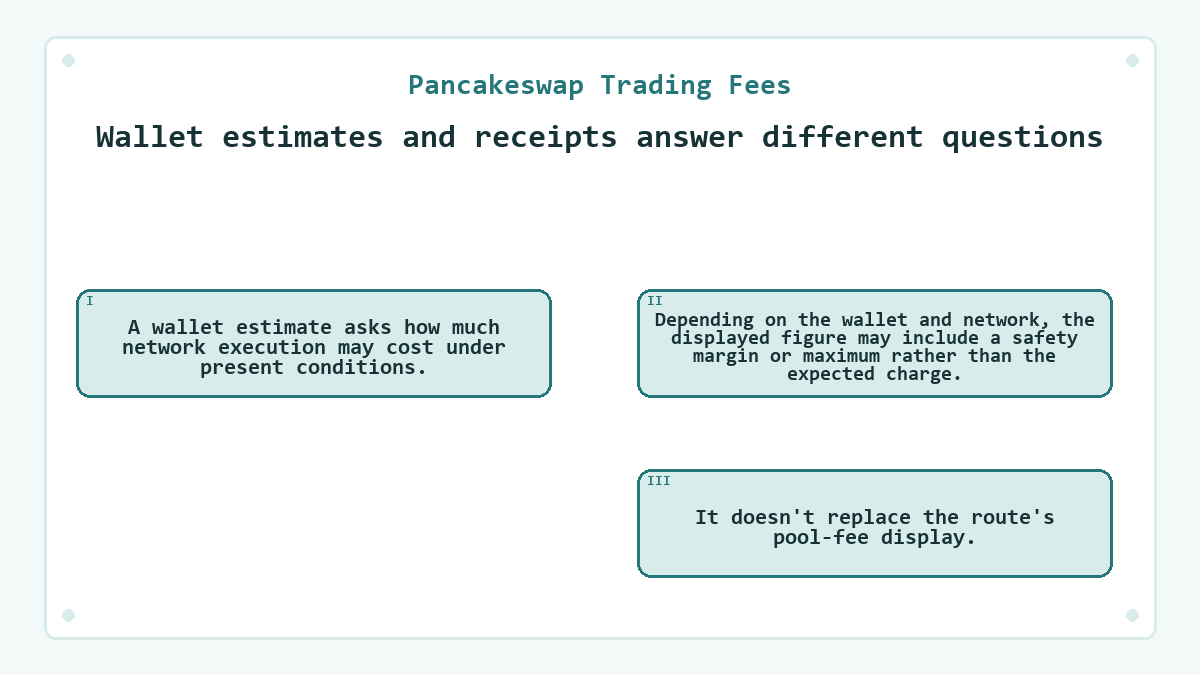
The confirmed record supplies the paid network amount. On many EVM-compatible networks, multiplying the receipt's effective gas price by its gas used gives the execution-gas component. Some rollups add L1 data or operator fees, which must be included separately in the total. If the wallet paid the fee, its native-asset balance should fall by the complete network charge, plus any native asset intentionally used as the swap input. Other network families use their own fee records, so their accounting shouldn't be forced into an EVM formula.
Does price impact count as a trading fee?
Price impact isn't a trading fee. It is the change in the available execution rate caused by moving through the route's liquidity. A larger order relative to active liquidity generally receives a less favorable average rate, even when the pool's percentage fee stays unchanged.
Slippage tolerance also isn't a predicted charge. It limits how far execution may move from the protected amount encoded for the transaction. Execution inside that boundary can produce a different output from an earlier screen without creating a separate slippage debit.
To isolate these effects, compare the route fee with the quoted input-output relationship. Then compare the protected amount with the tokens actually credited. That separates a fee calculation from an execution-rate change.
Token transfer logic can create a separate deduction
Some token contracts deduct, redirect, or burn part of a transfer. Such token-level logic can reduce the amount reaching a pool or wallet, and it may cause a swap to fail when the route can't satisfy its protected input or output conditions. That deduction isn't a Pancakeswap pool fee.
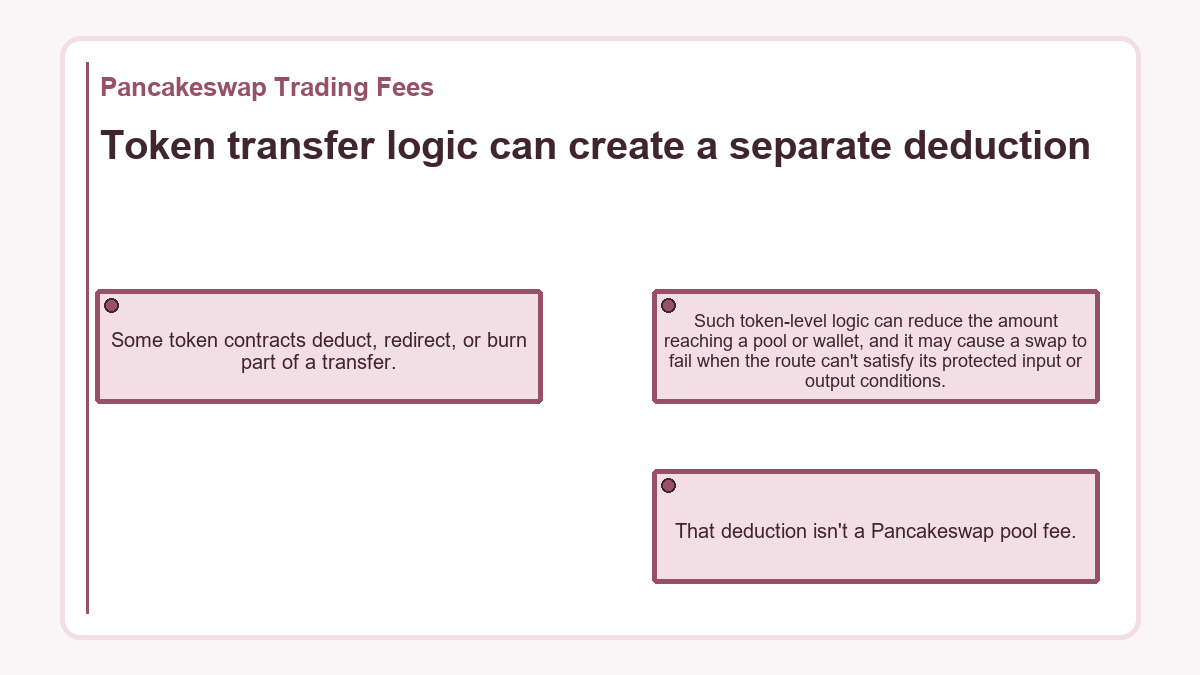
Transaction logs and balance changes reveal whether the full transferred amount reached its intended recipient. Raising slippage may allow certain fee-on-transfer tokens to execute, but it doesn't reclassify the token charge or make the route cheaper. A token restriction can also prevent execution regardless of the chosen tolerance.
A like-for-like reconciliation checklist
Keep the quote snapshot, wallet request, transaction identifier, and final balances together. Then check the same factual dimensions before assigning the difference to trading fees.
- Match the network, token contract addresses, direction, and input amount.
- Match the route, pool versions, fee tiers, and enabled liquidity sources.
- Separate the pool fee from approval gas and swap gas.
- Compare token quantities before applying any fiat conversion.
- Inspect transfer events when the credited output remains short.
What should you do when the numbers still don't agree?
Identify the unmatched category before changing the trade. A different route calls for a fresh quote comparison. A gas discrepancy calls for the confirmed network-fee record. A token-output discrepancy calls for the transaction's transfer events and the recipient's balance change.
Refresh the quote with the original amount and routing settings only if the old route no longer explains the display. Stop once every input debit, output credit, pool charge, and network charge has a matching record. Repeating the swap doesn't repair missing evidence and creates another transaction to reconcile.
The final account state closes the comparison
Start the final ledger with the input-token debit and output-token credit. Add the confirmed network fee in its native asset, and record any earlier approval gas separately. Keep token-level deductions distinct from route fees, and don't combine unlike assets until one valuation method and timestamp have been chosen. Once the route explains the trading charge and the transaction record explains every balance movement, the remaining decision is whether a new quote offers acceptable execution under the current configuration.
Pancakeswap Trading Fees: questions and answers
-
Is a token approval included in Pancakeswap Trading Fees?
- No. A token approval grants a contract permission to spend a specified token amount; it isn't a liquidity-pool trading fee. When approval requires its own on-chain transaction, the wallet pays a separate network fee. An existing sufficient allowance may remove the need for another approval. Record approval gas separately so a first swap isn't compared unfairly with a later swap using an existing allowance.
-
Can a reverted swap still create a network charge?
- Yes. A submitted transaction can consume network resources even when contract execution reverts and no swap output reaches the wallet. The confirmed record shows the network fee, while token balances show that the reverted swap's token transfers didn't take effect. A rejected wallet request isn't the same situation because it normally prevents broadcast. Check the transaction status before treating a missing output as a fee deduction.
-
When should fiat values be removed from a fee comparison?
- Remove fiat values whenever the quote, wallet, and transaction display use different conversion times or price feeds. Reconcile the input token, output token, and native gas asset in their original units first. If a single fiat total is still useful, apply one stated valuation time to every component. Otherwise, market movement between screens can appear to be a fee mismatch.
-
Are pool fees taken from the input or added to the output?
- A pool fee operates inside the swap calculation on the amount entering the relevant pool hop. It therefore affects the input-output relationship rather than appearing as an arbitrary output-token charge after settlement. When a route contains several hops or branches, each pool applies its own configuration to the portion passing through it. The quoted result should already reflect that route-level calculation.
-
Can token decimals and rounding explain a small mismatch?
- Yes. Token contracts represent balances in integer base units, while interfaces often shorten or round the displayed decimal value. A route can also round at intermediate calculations. Compare raw transferred amounts or the fullest available precision before concluding a fee is missing. Rounding usually explains only a small difference; a larger gap still requires checks for route changes, gas, price impact, or token transfer logic.
-
Where can the number of pools in a completed route be confirmed?
- The route details captured with the quote provide the clearest planned pool sequence or split. After execution, the transaction's contract calls and token-transfer events can corroborate the path, although a wallet may summarize rather than decode them. Don't infer the number of pools from the trading pair or one headline percentage. A direct route and a multihop route can involve the same visible input and output tokens.
-
Is a later token price change part of the completed swap cost?
- No. Market movement after confirmation changes the position's later value, not the trading fee already applied to the completed transaction. Keep the executed token quantities and native network fee as the historical record. If the cost must be expressed in fiat, use a consistent valuation time. Mixing a later market price with the earlier quote can create an apparent mismatch even though no additional charge occurred.